Baghban Syndrome: How One Movie Quietly Warped Middle-Class Money, Family, and Legacy
Fear of being “used” by your own children is not wisdom — it is a movie hangover. Bring the next generation on board, buy joint assets, and stay useful past retirement.
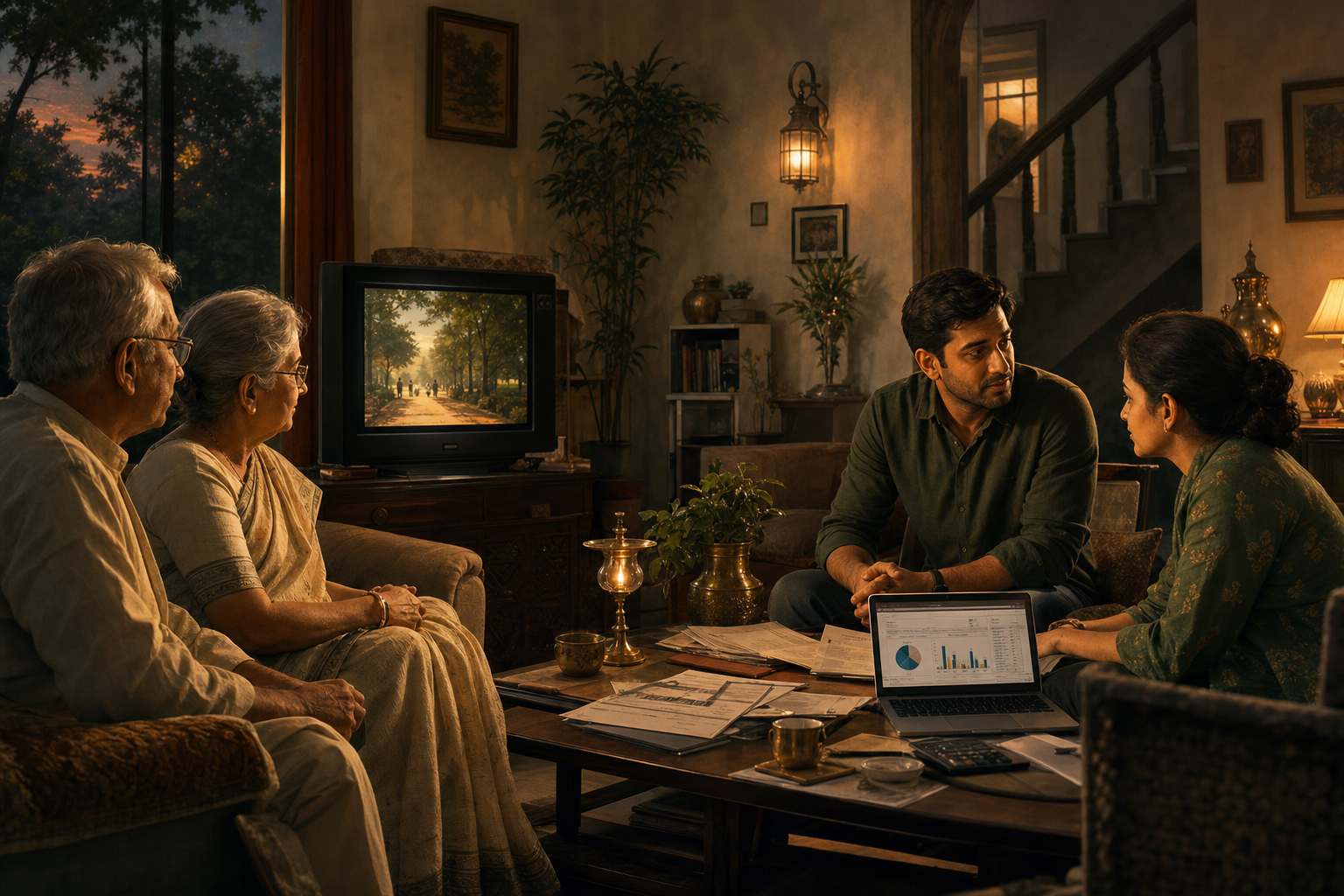
If this channel had to be summarised in one story, it would be this. Life investment. Real estate. Family architecture. Clarity. Today’s topic sits at the centre of all of it: Baghban Syndrome — the quiet fear that has shaped how an entire generation of Indian parents treat money, children, and old age.
This is not film criticism for its own sake. It is a practical discussion for parents, for people entering senior years, and for the children who will inherit not just assets — but the emotional climate around those assets.

A movie that outran market crashes
In my view, Baghban — with its unforgettable father-son rupture — has done more damage to middle-class and upper-middle-class financial psychology in India than many people care to admit. More emotional destruction, in some households, than Harshad Mehta’s scandal, the 2019 market mood, or even the 2008 correction.
That is my own research lens — not a claim about commissions or market data. It is a claim about omission: the opportunities families never took because the film put parents into a fear zone for years.
When the movie airs on television — and it still does, month after month — something subtle happens. Parents watching with teenagers or young adults slip onto a different road. Casual conversations freeze. Trust thins. Joint decisions that could have been taken together get postponed indefinitely.
Follow Amitabh Bachchan in real life — the family man who still shows up for his people. Do not follow the fear script of the character in the film.
Real life and reel life are not the same. In real life, family is family. Care is not “being used.” Taking care of your own is not weakness. The movie’s emotional gravity is powerful; the blueprint it leaves behind is dangerous if left unexamined.
 Fear forwards
Don’t amplify them
Fear forwards
Don’t amplify them
 Joint assets
Bring kids on board
Joint assets
Bring kids on board
 Purpose years
Don’t retire from usefulness
Purpose years
Don’t retire from usefulness
Signal one
1. Stop forwarding the “your kids will use you” messages
You have seen the WhatsApp warnings: be careful, your children will use you, protect yourself, don’t become a resource. Forwarding those messages is not wisdom. It is contagion.
Ask a simpler question. If your children must not “use” you — who has already used you?
- Your boss used your time and talent.
- Your organisation used your loyalty.
- Friends and relatives used your favours, your networks, your weekends.
For twenty, thirty, forty years you ran for promotions, stayed late, and spent energy keeping other people happy. Then, when your own children need a platform, suddenly the tank is empty and the slogan becomes: I must not be used.
I want to be useful to my kids. If I am not useful to my father, and not useful to my children — then whose village am I useful to?
Wanting to be useful is not exploitation. It is intergenerational design. If someone forwards you fear, do not perform piety by amplifying it. Delete it. Discuss it. Replace it with a family conversation.
Signal two
2. Ignore the circle that only says “look after yourself”
After 54–55, many people retire so completely that purpose evaporates. Advisors, friends, and relatives will say: look after yourself now; the purpose of life is only self-care.
The purpose of life, at its healthiest, is also to help someone. If you have already spent yourself on distant causes, the nearest beneficiaries are often your own children and household. You do not need an NGO to begin charity. In India, charity can start inside the house — and within a few metres of the front door.
Be careful of voices whose own families are not intact. Some people are lonely, emotionally unanchored, or living far from their children abroad. Their advice may be sincere — and still wrong for your household. In consulting rooms, this pattern repeats: people arrive for “open settings,” then discover their trust was parked with the wrong circle.
Base major decisions on your children — the next generation — not on the fear scripts of friends, and not even on the absolute preferences of very elderly parents alone.
Keep parents close. Honour them. But do not freeze a 30-year family strategy around an 85-year horizon that cannot carry the next generation forward.

Signal three
3. Stop being a secret “super investor” your family cannot decode
A familiar tragedy: a father runs 20–25 mutual funds, three demat accounts, scattered papers, and private “Gupta-style” cash habits. The spouse knows almost nothing. Then something happens — and the son, daughter-in-law, and relatives inherit chaos: missing nominations, spelling mistakes, unclear interest, locked accounts, and nights that destroy peace.
Society whispers that children only want to snatch. That whisper becomes a self-fulfilling isolation. If you gave the values, you should also be able to share the map.
Many seniors already have a house, a pension that continues for a spouse, and surplus capital — yet no clarity on what the money is for. Diversification without disclosure is not sophistication. It is a future administrative fire.
A practical fix: put the next generation on board
Children may not be financially hungry. That is not the point. Bring them into joint assets anyway.
- Buy property together where structure allows.
- Let them service EMIs while you contribute capital or guarantee direction.
- In many blood-relation transfers, property can move within the family with far less friction than people assume — father to child, and onward inside the family tree.
- Children can manage rental operations and remit your share — turning idle capital into a living family system.
Idle money sitting in opaque funds, forgotten demats, and paper trails that only one person understands is one of India’s quietest wealth leaks. The category is huge precisely because people refuse to talk.
After the signals
Do not retire from usefulness
When you retire, do not shut the engine. Walk. Think. Work carefully. Earn where dignity allows. The moment you decide “this pile of money must be guarded forever because someone will snatch it,” you enter a bunker psychology that ages badly.
Many people spend 30–35 prime years on jobs, training, marriage, children, and survival — then arrive at the later decades with no script. Those decades are not leftover scraps. They are a second career of purpose.
A father’s heart must stay large. Children may be busy. Respect may arrive unevenly. Your job is still to remain the shade of calm in the house — and to keep doing your karma. Magic often follows consistency, not scorekeeping.
What “support” actually means
Raising a child until 22 is not a medal. Most households do that. The harder, rarer work is remaining useful after that — without turning WhatsApp groups into theatres of parental virtue while neglecting your own next generation.
Yes, you must also protect your own health, sleep, and dignity. But a life that stays useful to the next generation tends to stay healthier. The body listens when the mind still has something to build.
Retirement filled only with TV, newspapers, and idle scrolling becomes dangerous. Irritability rises. Life expectancy is rising — every year adds more of these decades. Take that seriously.
The father’s role — and why wealth must gather the family
In many families, a mother’s role narrows after a point under cultural weight and pain she has already carried. A father’s role remains structurally large: to keep the system coherent while he is alive.
If your wealth and your systems cannot keep your family together, the success you think you earned does not fully count.
Money should visibly work for you and your children. Property and surplus are not only for private satisfaction; they should carry a next-generation call. We do not want our children to say, “Father worked so hard — and for what?” We earn so that the family can climb.
बाप बाप होता है। Unfortunately, many people understand that fully only after he is gone. Do not wait for that lesson.
Closing
Baghban Syndrome is not about hating a film. It is about refusing a fear that has outlived its entertainment value. Do not forward the poison. Do not outsource family strategy to lonely advisors. Do not hide your capital from the people who must eventually steward it.
Bring the next generation on board. Buy together. Stay useful. Keep your heart large. That is what a channel about life investment is actually about — and that is the clarity this discussion is meant to leave behind.